Large Loss and Catastrophic Response in Colorado Springs
24/7 large loss and catastrophic response in Colorado Springs and surrounding areas. IICRC-certified, insurance billing accepted. Call (303) 656-9934.
When a loss crosses a threshold, a burst main flooding multiple floors of an office building, a fire that takes out an entire wing of an apartment complex, a hailstorm that damages roofing across a commercial portfolio, the response can’t look like a standard residential job scaled up. Large loss and catastrophic response in Colorado Springs means coordinating multiple drying zones, managing contents across a commercial footprint, and documenting everything to a standard that satisfies large loss adjusters and risk managers, not just a homeowner’s claims rep.
What Large Loss and Catastrophic Response actually involves
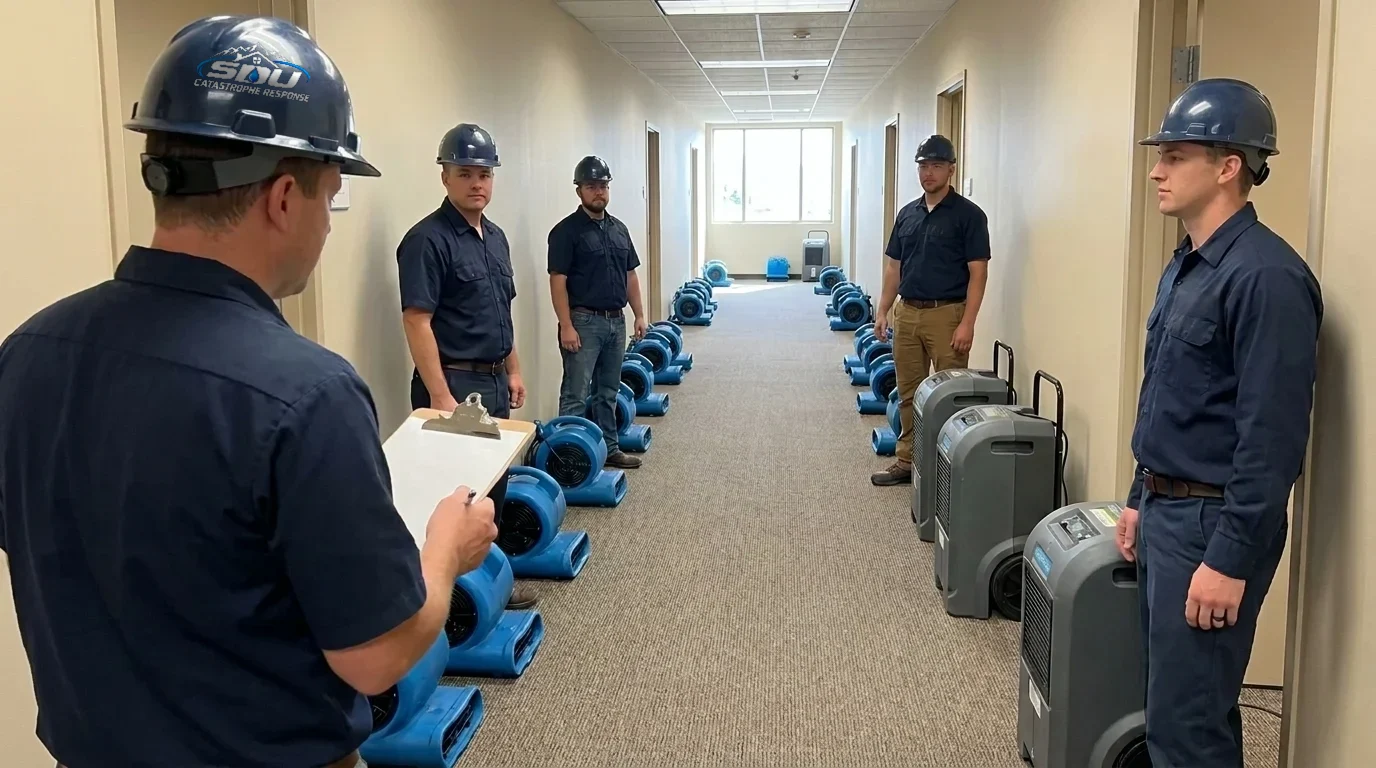
A large loss is typically defined by dollar threshold or scale, not just by damage type: think multi-unit residential buildings, commercial properties, institutional facilities, or any single event affecting 10,000+ square feet or multiple structures. These losses often combine water, fire, or storm damage with business interruption pressure, meaning the clock matters in a different way than it does for a single homeowner. Equipment deployment scales accordingly: desiccant dehumidifiers instead of a handful of refrigerant units, truck-mounted extraction paired with portable extraction crews working in parallel zones, and air movers numbering in the dozens rather than a handful placed by sq ft calculation. Monitoring shifts from spot checks to a structured daily log across every affected zone, because a catastrophic loss can run weeks rather than days and the paper trail has to hold up.
Timeline depends heavily on scope. A single-building commercial water loss might stabilize in 5 to 10 days. A multi-structure fire or storm event affecting a residential complex can run into months once reconstruction is factored in. What stays constant is the need for a project manager who is tracking moisture data, labor hours, equipment logs, and contents inventory simultaneously, because large loss claims get scrutinized line by line.
Our process
- Scene assessment and loss triage - before equipment moves, the crew maps the affected structure or structures, identifies life-safety hazards, and prioritizes zones by severity and business or habitability impact.
- Mobilization and resource staging - large loss response means pulling in the equipment and labor a single-structure job never needs: multiple drying trailers, generator power if utilities are compromised, and crew rotation for multi-day stabilization.
- Zone-by-zone mitigation - water extraction, fire and smoke mitigation, or storm damage stabilization proceeds structure by structure or floor by floor, each zone tracked independently so drying or cleanup in one area doesn’t get lost in the overall project scope.
- Daily documentation and adjuster coordination - moisture logs, photo documentation, and labor and equipment tracking are compiled daily, not at project close, so large loss adjusters have a running record rather than a reconstructed one.
- Scope handoff to reconstruction or closeout - once mitigation is complete, the project transitions into a documented scope of work for repairs, or closes out with final moisture verification and a complete claim file.
What separates a good large loss response from a bad one
The most common failure on a catastrophic loss is treating it like several small jobs instead of one coordinated project. Crews that don’t centralize documentation end up with gaps: a moisture log for one floor but not another, equipment logs that don’t match invoiced hours, or contents inventories that are incomplete when the adjuster asks for them. Large loss adjusters are trained to look for exactly these inconsistencies, because they’re the difference between a claim that pays cleanly and one that gets disputed line by line.
Another frequent mistake is under-resourcing the drying phase. A building that needs industrial dehumidification gets a handful of consumer-grade units instead, which stretches the timeline and increases the risk of secondary damage like mold colonization in wall cavities or under flooring. Structural drying on a catastrophic scale has to be calculated and verified against the IICRC S500 standard, with daily psychrometric readings, not estimated by eye.
What does Large Loss and Catastrophic Response cost?
Large loss costs vary enormously based on structure size, number of buildings affected, and whether reconstruction is included in the final scope. These figures are typical industry ranges, not a quote, every loss gets a written scope of work before any mitigation begins so the property owner and the adjuster are looking at the same numbers. Commercial property insurance and large loss policies typically cover mitigation and reconstruction costs tied to a covered peril, though policy limits and sub-limits for specific damage types vary.
| Scenario | Typical range |
|---|---|
| Single commercial unit, water loss | $15,000 - $50,000 |
| Multi-unit residential building, water or fire loss | $50,000 - $250,000 |
| Mixed-use commercial structure, storm damage | $75,000 - $300,000 |
| Multi-structure catastrophic event | $250,000 - $1,000,000+ |
| Large commercial fire with contents loss | $300,000 - $2,000,000+ |
Seasonal & regional considerations
Colorado Springs sees a distinct catastrophic loss pattern tied to its climate: late spring and summer hailstorms that damage roofing across entire neighborhoods and commercial parks in a single event, and winter freeze-thaw cycles that cause pipe failures across older multi-unit buildings built before modern insulation codes. Both patterns can generate true large loss scenarios, multiple structures affected on the same day, which is why coordinated response across several properties at once is a regular part of the work here rather than an edge case.
Service area
SDU Catastrophe Response handles large loss and catastrophic events across Colorado Springs and the surrounding region, including commercial corridors, multi-family housing, and institutional properties throughout the area.
If you’re managing a loss that spans multiple units, floors, or structures, don’t wait for the scope to grow while you gather bids. Call SDU Catastrophe Response at (303) 656-9934 to get a large loss team mobilized and a documented scope of work started.
Frequently Asked Questions
What qualifies as a large loss versus a standard claim?
Does homeowners or commercial insurance cover large loss and catastrophic response?
How is a multi-building catastrophic loss coordinated across different structures?
What kind of equipment is deployed on a catastrophic loss that isn't used on a smaller job?
What should a property manager do in the first hours after a catastrophic event?
Looking for the best large loss and catastrophic response company in Colorado Springs?
SDU Catastrophe Response provides large loss and catastrophic response in Colorado Springs, CO and the surrounding area. We answer calls 24/7 — call (303) 656-9934 for immediate help.
Need Large Loss and Catastrophic Response now?
We respond 24/7 across Colorado Springs and surrounding CO cities.